
If you move to Portugal and start paying for normal daily life, one of the first confusing things you will notice is that people say MB Way and Multibanco as if everyone already knows the difference.
Foreigners often do not. That is where avoidable payment problems start. A bill arrives with an entity and reference number. A shop says it is “Multibanco only”. A Portuguese friend pays from a phone in seconds while your foreign card does something different. None of that is obvious if you have just arrived.
This guide explains MB Way and Multibanco in plain English, what each one does, where a Portuguese bank account changes the situation, how foreign cards fit in, and what to check before relying on one payment method only.
Last verified: April 26, 2026. App features, bank support, fees, and merchant payment setup can change. Confirm the current rule with your bank or the official service before relying on it for an urgent payment.
Quick answer
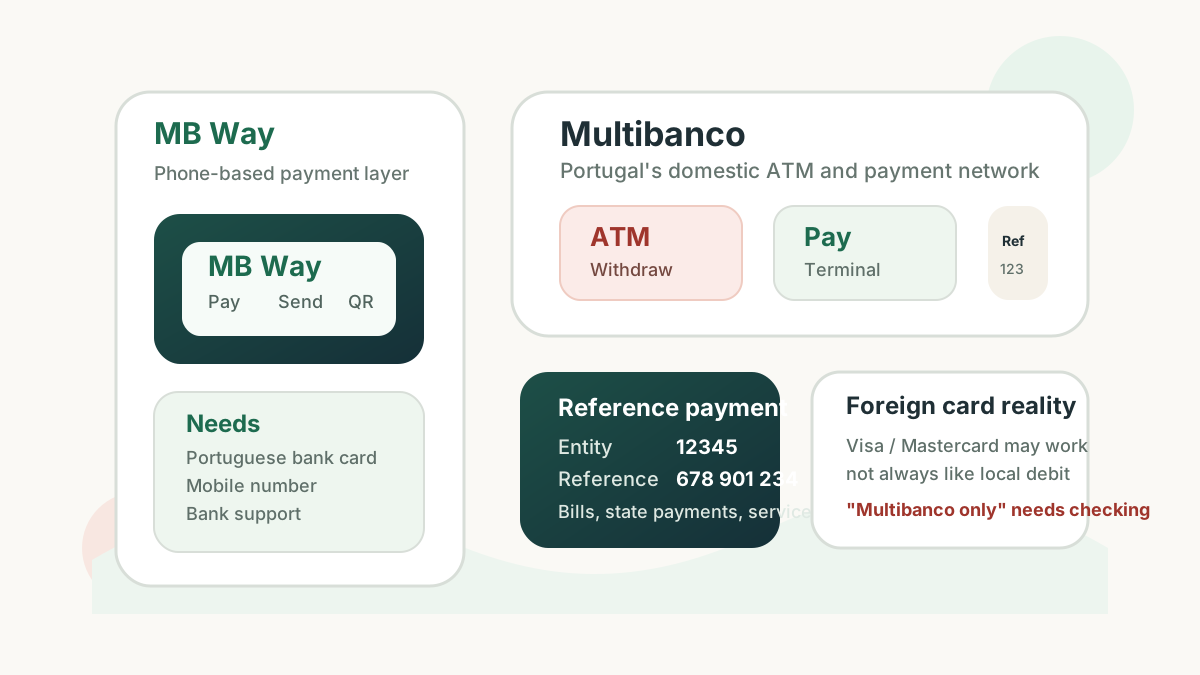
MB Way is a mobile payment service linked to participating Portuguese bank cards. Multibanco is the Portuguese domestic ATM and card-payment network that people use for cash withdrawals, service payments, transfers, and many everyday card payments.
They are connected, but they are not the same thing.
- MB Way lives on your phone
- Multibanco is the network behind many Portuguese ATMs and local debit-style payment flows
- You usually need a participating Portuguese bank card to use MB Way properly
- You do not always need a Portuguese phone number, because MB Way officially allows international numbers linked to an eligible Portuguese bank card
- Foreign cards, Revolut, and Wise can still be useful in Portugal, but they do not always behave exactly like a local Portuguese bank card on the Multibanco system
If you understand that one difference early, a lot of Portuguese payment confusion disappears.
Who this guide is for
This guide is for foreigners who:
- just opened, or plan to open, a Portuguese bank account
- keep hearing about MB Way and Multibanco but are not sure what each one is
- need to pay rent-related bills, utilities, taxes, or service charges in Portugal
- are trying to live with Revolut, Wise, or another foreign card setup
- want to avoid payment errors and common scams
It is general financial information, not personal banking advice.
MB Way explained
MB Way is a Portuguese mobile payment service. In practice, it lets you use a participating bank card through your phone for things like:
- paying in shops
- paying online
- sending money
- requesting money
- generating MB NET virtual cards
- withdrawing cash without using the physical bank card
- opening some Multibanco functions from the phone
The important point for foreigners is this: MB Way is not a replacement for the underlying bank relationship. It usually sits on top of a Portuguese bank card from a participating bank.
That is why people who arrive with only a foreign card often hear about MB Way but cannot immediately use it in the same way their Portuguese friends do.
Multibanco explained
Multibanco is the domestic network that powers a large part of everyday Portuguese card and ATM life.
Banco de Portugal explains that cards carrying the Multibanco brand can be used for more than cash withdrawal. They can also be used on the connected ATM network for services such as:
- service payments
- payments to the state
- ATM transfers
That is why Portuguese ATMs often feel more functional than ATMs in other countries. They are not only for cash. They are part of a wider local payment system.
For a foreigner, Multibanco usually matters in three places:
- ATMs where you withdraw cash or pay certain references
- Shops and terminals where domestic debit behavior may differ from your foreign card experience
- Reference payments used for bills, taxes, and some online or service payments
MB Way vs Multibanco
Here is the simplest practical distinction:
| Term | What it is | What foreigners usually notice first |
|---|---|---|
| MB Way | Mobile payment service linked to eligible bank cards | Paying by phone, sending money, online checkout, cash withdrawal without card |
| Multibanco | Portuguese domestic ATM and payment network | Local ATMs, service payments, domestic debit-style card acceptance, references |
One useful way to think about it:
- MB Way is a tool
- Multibanco is part of the infrastructure
They overlap, but they are not interchangeable words.
Do you need a Portuguese bank account and phone number?
For most practical use, you should assume that a Portuguese bank relationship is the starting point.
Portuguese bank account
If you want the full local experience, including easier MB Way use and smoother integration with local payment habits, a Portuguese bank account is usually the safest path. Start with our guide to opening a bank account in Portugal as a foreigner.
MB Way setup is tied to a participating bank card. If your bank is not in the participating list, or if your bank app handles MB Way poorly, your experience may be limited even if you already have a Portuguese account.
Phone number
Many foreigners assume they need a Portuguese phone number. That is not always true. MB Way has an official page stating that international mobile numbers can use MB Way, as long as they are associated with a participating Portuguese bank card.
That is useful, but do not read it too broadly. The real question is not only “can the number exist?” but:
- will your bank accept your setup cleanly?
- will your activation SMS and security flow work reliably?
- will you want a Portuguese number anyway for banking and other local services?
In practice, many foreigners still end up using a Portuguese number because it keeps day-to-day administration simpler.
Can MB Way work with every Portuguese bank?
No. It depends on whether the bank or card issuer participates. Check the current MB Way participating-bank list before you rely on it.
If your bank technically participates but your app experience is weak, you may still find MB Way less smooth than expected.
What if your bank app does not support MB Way well?
This is more common than newcomers expect. Sometimes the bank participates, but:
- activation is awkward
- some features are slower to appear
- the bank pushes you toward its own app flow
- support staff explain only the bank side, not the MB Way side
If that happens:
- check the official MB Way participating-bank list again
- ask your bank whether MB Way setup should happen in the bank app, the MB Way app, or both
- test basic functions first, such as payment and cash withdrawal, before you depend on them for rent-day or travel
- keep one backup method while the setup is still new
What you can do at a Multibanco ATM
This is one of the most useful sections for newcomers because Multibanco is more than “cash machine”.
Depending on the card and function available, a Multibanco ATM may let you:
- withdraw cash
- pay a service or bill using entity and reference
- pay some state-related charges
- transfer money
- use certain MB Way features without the physical card
MB Way also officially supports:
- generating a cash-withdrawal code in the app
- using the green key and QR flow to open Multibanco functions without inserting the card
That matters when:
- you forgot your wallet
- you only have your phone
- you received a Portuguese reference to pay
- you need to do more than take out cash
Entity and reference payments explained
This is one of the most Portuguese things in everyday banking.
An entity/reference payment is a local payment method that usually gives you:
- an entity number
- a reference number
- sometimes an exact amount
You then go to a supported bank app, home banking service, or Multibanco ATM and pay using that reference.
Foreigners commonly see this for:
- utilities
- some public charges
- taxes
- services
- online purchases with local payment options
Why it feels strange at first
If you come from a system where almost everything is paid by card, direct debit, or IBAN transfer, entity/reference payments can look suspicious or unnecessarily complicated.
Usually, they are simply a local payment rail.
What to check before paying
- who sent the reference
- whether the amount matches what you expected
- whether the due date is still valid
- whether it is coming from the official merchant, landlord, supplier, or authority you expect
Do not pay a random reference sent over chat unless you understand exactly what it is for.
Using foreign cards, Revolut, and Wise in Portugal
This is where foreigners often get caught out by practical differences.
Foreign cards may work, but not always in the same way
A foreign Visa or Mastercard may work perfectly in one shop, another shop, and an ATM, and then still fail in a situation where a Portuguese bank card would usually work smoothly.
That does not automatically mean the merchant is doing something illegal. Card acceptance can differ by:
- payment brand
- card category
- terminal setup
- domestic versus international routing
Banco de Portugal says that if a merchant does not accept all categories of a payment system, that information should be shown clearly to consumers before payment.
What if a shop says “Multibanco only”?
In practice, this often means the merchant expects a local debit-style payment route and not every foreign card behaves the same way there.
What to do:
- Ask whether they accept Visa or Mastercard debit or credit.
- If the payment fails, try another card rather than assuming all foreign cards are blocked.
- Keep a backup method: cash, a second card, or a Portuguese account/card setup.
Can Revolut or Wise be used the same way?
Not always.
They are useful for:
- spending
- online purchases
- SEPA transfers
- keeping euro funds ready
But they may not fully replace a local Portuguese setup if you need:
- full MB Way compatibility
- easy local reference payments
- the most predictable domestic card behavior
- fewer surprises with merchants or service providers
The practical rule is simple: if Portugal is becoming your normal day-to-day base, test your payment setup early rather than discovering the gap during rent, tax, or utility deadlines.
Common fees and limits
Do not assume all app payments are free forever.
Banco de Portugal explains that payment-service providers may charge for payment-app operations, but there are legal limits around what can be charged for certain third-party app transfers. The public explanation includes a common monthly threshold structure for transfers up to:
- 30 euros per operation
- 150 euros per month
- 25 transfers per month
If you go beyond those limits, fees may apply depending on the provider and the app structure.
Also check:
- your bank’s price list
- foreign-card cash withdrawal fees
- currency conversion charges
- private ATM fee warnings on screen
- whether the app feature you want is fully supported by your bank
If you are still building your Portugal setup, do not ignore fees. Small charges become annoying quickly when they hit rent-month, travel, and bank-transfer tasks at the same time.
Common scams and safety tips
MB Way is convenient, which also means scammers like to use the name.
MB Way itself warns users:
- never share the six-digit PIN
- never follow instructions from strangers to join or make payments
Common scam patterns
- someone says they want to “send” you money but walks you through steps that actually make you authorize something
- a fake buyer or seller asks you to use an ATM in a specific way
- a fake support message claims you must revalidate MB Way urgently
- a fake reference payment is sent over chat without any trustworthy invoice or service context
Safer habits
- set up MB Way yourself, not with help from a stranger
- use only official app flows
- verify references and merchant identity before payment
- stop immediately if someone is talking you through ATM or app steps in real time
- contact your bank fast if something looks wrong
What can go wrong
These are the problems foreigners hit most often:
- you only have a foreign card and discover a local payment expects Multibanco behavior
- you think MB Way is just “Portuguese Apple Pay” and miss its banking requirements
- your bank technically supports MB Way but not every feature works the way you expected
- you get an entity/reference request and assume it is fake when it is actually normal
- you trust a fake buyer or seller because they use familiar Portuguese payment words
- you arrive at a shop with one payment option and no backup
None of this is dramatic if you prepare once. It becomes stressful only when you discover it during a deadline or at the till.
Practical checklist
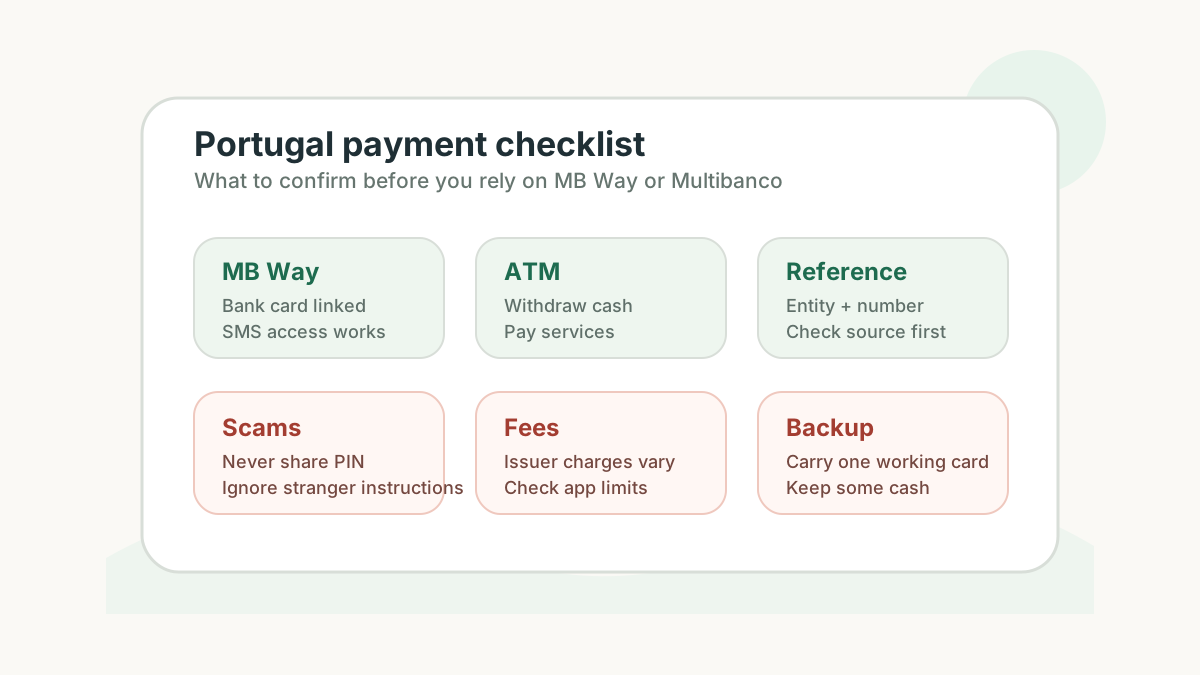
Before relying on MB Way or Multibanco in Portugal, check:
- Do I already have a Portuguese bank account if I need local banking features?
- Is my bank or card issuer on the MB Way participating list?
- Will my phone number receive activation and security messages reliably?
- Do I understand how to pay an entity/reference request?
- Do I know how to withdraw cash if I do not have my physical card?
- Have I checked likely card or ATM fees on my setup?
- Do I have a backup payment option?
- Do I know the basic scam rule: never follow stranger instructions in real time?
Summary
MB Way and Multibanco are central to normal financial life in Portugal, but they solve different problems.
MB Way is the mobile service. Multibanco is the local payments and ATM network behind much of everyday Portuguese banking behavior.
If you are a foreigner in Portugal, the safest approach is:
- understand the distinction early
- get a Portuguese banking setup if your daily life depends on local payment flows
- learn entity/reference payments before you need them urgently
- keep a backup payment method
- treat any pressure-filled payment instructions as suspicious until proven otherwise
Once you understand those basics, Portuguese payments stop feeling mysterious and start feeling predictable.